
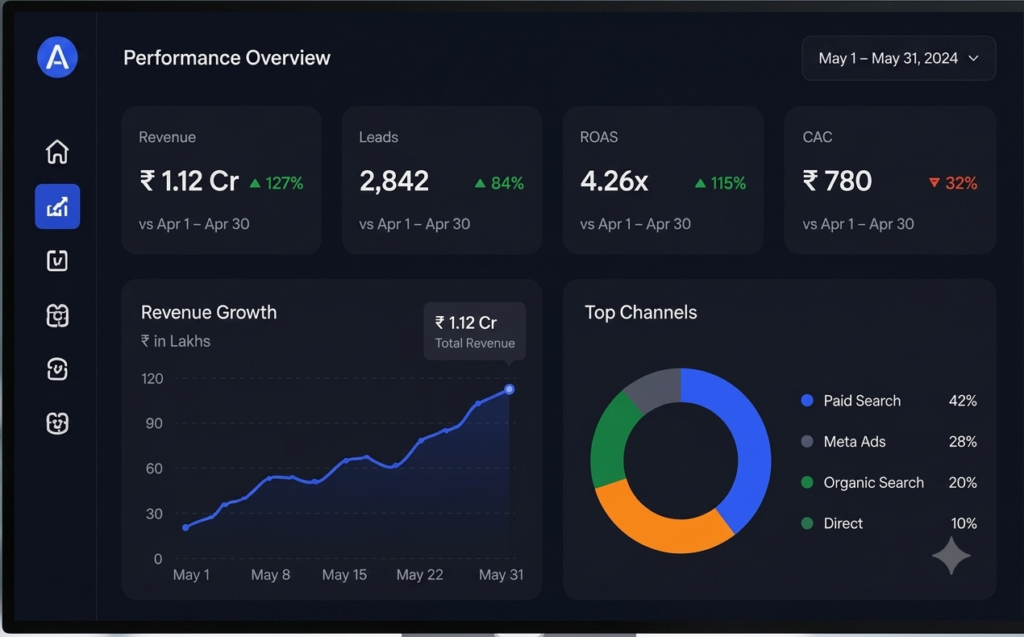
ROAS
ROAS Explained: How to Measure and Improve Your Return on Ad Spend An SEO-friendly blog post for Digital Ark — your digital marketing agency. This article explains what ROAS means, how to calculate it, why it matters for businesses, and how to improve advertising performance through smarter digital marketing strategies. Primary keyword: ROAS Suggested secondary keywords: What is ROAS, return on ad spend, ROAS formula, how to calculate ROAS, good ROAS, ROAS in digital marketing, how to improve ROAS, ROAS vs ROI, Google Ads ROAS, Facebook Ads ROAS. Suggested URL slug: /blog/what-is-roas Category: Digital Marketing · Paid Advertising · Performance Marketing Introduction: Why ROAS Matters in Digital Marketing In today’s competitive digital landscape, businesses invest heavily in advertising across platforms such as Google Ads, Meta Ads, Instagram, and YouTube. But one important question remains: Are your advertising campaigns generating enough revenue to justify the money you’re spending? This is where ROAS, or Return on Ad Spend, becomes an essential marketing metric. ROAS helps businesses understand how much revenue they generate for every rupee spent on advertising. Whether you run an e-commerce store, a startup, or an established business, tracking ROAS can help you make more informed advertising and budget-allocation decisions. In this guide, we’ll explore what ROAS means, how to calculate it, what constitutes a healthy ROAS, and how businesses can improve their advertising performance. What Is ROAS? ROAS stands for Return on Ad Spend. It is a digital marketing metric used to measure the revenue generated by an advertising campaign relative to the amount spent on that campaign. Simply put, ROAS answers the question: “How much revenue did my business generate for every ₹1 spent on advertising?” For example, if you spend ₹10,000 on Google Ads and generate ₹40,000 in revenue from those ads, your ROAS is 4x. This means you generated ₹4 in attributed revenue for every ₹1 spent on advertising. ROAS is widely used to evaluate paid advertising campaigns and compare the revenue efficiency of different channels, campaigns, and ad groups. How to Calculate ROAS: The ROAS Formula Calculating ROAS is straightforward. You only need two numbers: Revenue attributed to your advertising campaign. Total advertising expenditure. ROAS formula ROAS = Revenue from AdsAdvertising Cost\frac{\text{Revenue from Ads}}{\text{Advertising Cost}}Advertising CostRevenue from Ads ROAS is usually expressed as a ratio, such as 2x, 4x, or 6x. Example of ROAS calculation Suppose you own an online fashion store and invest ₹50,000 in Meta Ads during a month. Total advertising spend: ₹50,000 Revenue attributed to ads: ₹2,00,000 Using the ROAS formula: ROAS=₹2,00,000₹50,000=4x\text{ROAS}=\frac{₹2,00,000}{₹50,000}=4xROAS=₹50,000₹2,00,000=4x Your ROAS is 4x. This means that your campaigns generated ₹4 in attributed revenue for every ₹1 spent on advertising. Important: ROAS measures revenue, not profit. A 4x ROAS does not automatically mean that your business is profitable. What Is a Good ROAS? One of the most common questions businesses ask is: What is a good ROAS? There is no universal ROAS benchmark that works for every business. A suitable target depends on your product margins, operating costs, average order value, industry, customer lifetime value, and advertising model. For example, a business with high profit margins may be able to operate at a lower ROAS than a business with very thin margins. How to determine your target ROAS Your break-even ROAS depends on the contribution margin available to cover advertising costs. A simplified formula is: Break-even ROAS=1Contribution margin as a decimal\text{Break-even ROAS}=\frac{1}{\text{Contribution margin as a decimal}}Break-even ROAS=Contribution margin as a decimal1 For example, if your contribution margin before advertising is 40%: Break-even ROAS=10.40=2.5x\text{Break-even ROAS}=\frac{1}{0.40}=2.5xBreak-even ROAS=0.401=2.5x This means you need approximately 2.5x ROAS to cover the contribution costs included in that calculation. Your actual break-even point may be higher or lower depending on shipping, returns, taxes, fixed overheads, and the costs included in your margin calculation. ROAS vs. ROI: What’s the Difference? ROAS and ROI are related but measure different things. Example You spend ₹20,000 on advertising and generate ₹80,000 in attributed revenue. Your ROAS is: 80,00020,000=4x\frac{80,000}{20,000}=4×20,00080,000=4x However, after accounting for product costs, salaries, logistics, software, and other expenses, your business may earn much less than the revenue figure suggests. Key takeaway: ROAS helps measure advertising efficiency, while ROI provides a broader view of financial returns. Why Is ROAS Important for Businesses? Tracking ROAS can help businesses evaluate their paid advertising efforts and make better decisions about campaign budgets. 1. Measure advertising performance ROAS helps you understand how effectively your advertising budget is generating attributed revenue. For example, if one campaign generates a 4x ROAS and another generates a 1.5x ROAS, you can investigate why their results differ. 2. Allocate your marketing budget Businesses can use ROAS alongside profit margins and other performance metrics to identify campaigns that may deserve further testing or investment. A campaign with a higher ROAS is not automatically the best campaign to scale. It is important to consider its profitability, volume, and growth potential. 3. Identify underperforming campaigns A low ROAS may indicate issues with targeting, creative quality, landing pages, product pricing, conversion rates, or campaign measurement. Analyzing these factors can help marketers identify opportunities for improvement. 4. Improve marketing profitability When combined with product margins and operating costs, ROAS can help businesses understand how advertising expenditure affects their financial performance. 5. Make data-driven decisions Rather than relying on assumptions, businesses can use campaign data to test new audiences, creative concepts, bidding strategies, and landing pages. How to Improve Your ROAS Improving ROAS requires more than simply reducing ad spend. The objective is to generate more valuable conversions while managing costs effectively. Here are several practical strategies. Improve your audience targeting Reaching the right audience can help reduce wasted advertising spend. Analyze customer demographics and buying behavior. Use relevant audience segments. Test remarketing campaigns where appropriate. Exclude audiences that consistently generate poor-quality results. Create better ad creatives Your advertisements need to capture attention and communicate a clear value proposition. Experiment with: Different headlines and ad copy. Product demonstrations. Short-form videos. Customer testimonials. Different calls to action. Optimize your landing pages Even an effective advertisement may fail to generate sales if the landing page creates friction. Focus on: Fast loading speeds. Mobile-friendly design. Clear