Roas
ROAS

ROAS

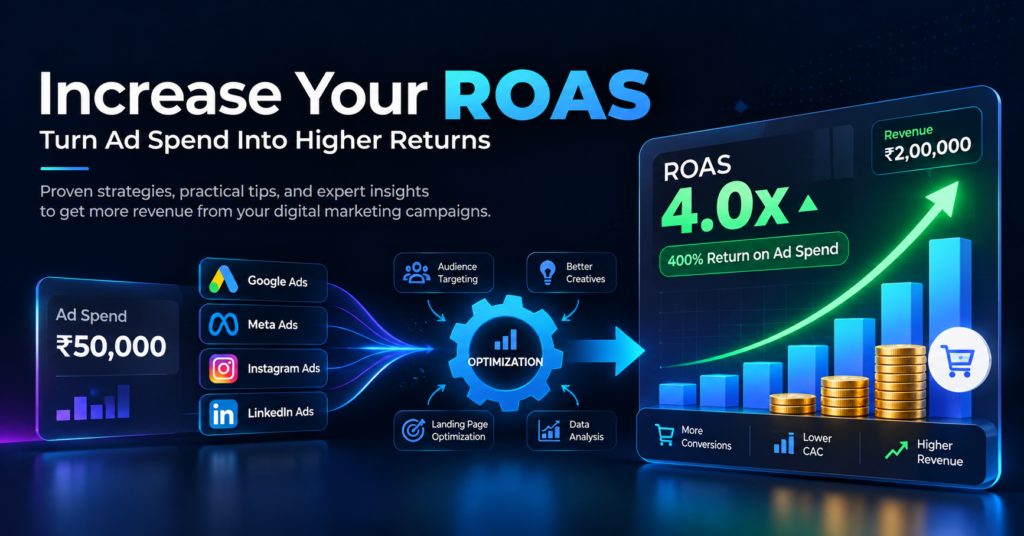
ROAS Explained: How to Measure and Improve Your Return on Ad Spend An SEO-friendly blog post for Digital Ark — your digital marketing agency. This article explains what ROAS means, how to calculate it, why it matters for businesses, and how to improve advertising performance through smarter digital marketing strategies. Primary keyword: ROAS Suggested secondary keywords: What is ROAS, return on ad spend, ROAS formula, how to calculate ROAS, good ROAS, ROAS in digital marketing, how to improve ROAS, ROAS vs ROI, Google Ads ROAS, Facebook Ads ROAS. Suggested URL slug: /blog/what-is-roas Category: Digital Marketing · Paid Advertising · Performance Marketing Introduction: Why ROAS Matters in Digital Marketing In today’s competitive digital landscape, businesses invest heavily in advertising across platforms such as Google Ads, Meta Ads, Instagram, and YouTube. But one important question remains: Are your advertising campaigns generating enough revenue to justify the money you’re spending? This is where ROAS, or Return on Ad Spend, becomes an essential marketing metric. ROAS helps businesses understand how much revenue they generate for every rupee spent on advertising. Whether you run an e-commerce store, a startup, or an established business, tracking ROAS can help you make more informed advertising and budget-allocation decisions. In this guide, we’ll explore what ROAS means, how to calculate it, what constitutes a healthy ROAS, and how businesses can improve their advertising performance. What Is ROAS? ROAS stands for Return on Ad Spend. It is a digital marketing metric used to measure the revenue generated by an advertising campaign relative to the amount spent on that campaign. Simply put, ROAS answers the question: “How much revenue did my business generate for every ₹1 spent on advertising?” For example, if you spend ₹10,000 on Google Ads and generate ₹40,000 in revenue from those ads, your ROAS is 4x. This means you generated ₹4 in attributed revenue for every ₹1 spent on advertising. ROAS is widely used to evaluate paid advertising campaigns and compare the revenue efficiency of different channels, campaigns, and ad groups. How to Calculate ROAS: The ROAS Formula Calculating ROAS is straightforward. You only need two numbers: Revenue attributed to your advertising campaign. Total advertising expenditure. ROAS formula ROAS = Revenue from AdsAdvertising Cost\frac{\text{Revenue from Ads}}{\text{Advertising Cost}}Advertising CostRevenue from Ads ROAS is usually expressed as a ratio, such as 2x, 4x, or 6x. Example of ROAS calculation Suppose you own an online fashion store and invest ₹50,000 in Meta Ads during a month. Total advertising spend: ₹50,000 Revenue attributed to ads: ₹2,00,000 Using the ROAS formula: ROAS=₹2,00,000₹50,000=4x\text{ROAS}=\frac{₹2,00,000}{₹50,000}=4xROAS=₹50,000₹2,00,000=4x Your ROAS is 4x. This means that your campaigns generated ₹4 in attributed revenue for every ₹1 spent on advertising. Important: ROAS measures revenue, not profit. A 4x ROAS does not automatically mean that your business is profitable. What Is a Good ROAS? One of the most common questions businesses ask is: What is a good ROAS? There is no universal ROAS benchmark that works for every business. A suitable target depends on your product margins, operating costs, average order value, industry, customer lifetime value, and advertising model. For example, a business with high profit margins may be able to operate at a lower ROAS than a business with very thin margins. How to determine your target ROAS Your break-even ROAS depends on the contribution margin available to cover advertising costs. A simplified formula is: Break-even ROAS=1Contribution margin as a decimal\text{Break-even ROAS}=\frac{1}{\text{Contribution margin as a decimal}}Break-even ROAS=Contribution margin as a decimal1 For example, if your contribution margin before advertising is 40%: Break-even ROAS=10.40=2.5x\text{Break-even ROAS}=\frac{1}{0.40}=2.5xBreak-even ROAS=0.401=2.5x This means you need approximately 2.5x ROAS to cover the contribution costs included in that calculation. Your actual break-even point may be higher or lower depending on shipping, returns, taxes, fixed overheads, and the costs included in your margin calculation. ROAS vs. ROI: What’s the Difference? ROAS and ROI are related but measure different things. Example You spend ₹20,000 on advertising and generate ₹80,000 in attributed revenue. Your ROAS is: 80,00020,000=4x\frac{80,000}{20,000}=4×20,00080,000=4x However, after accounting for product costs, salaries, logistics, software, and other expenses, your business may earn much less than the revenue figure suggests. Key takeaway: ROAS helps measure advertising efficiency, while ROI provides a broader view of financial returns. Why Is ROAS Important for Businesses? Tracking ROAS can help businesses evaluate their paid advertising efforts and make better decisions about campaign budgets. 1. Measure advertising performance ROAS helps you understand how effectively your advertising budget is generating attributed revenue. For example, if one campaign generates a 4x ROAS and another generates a 1.5x ROAS, you can investigate why their results differ. 2. Allocate your marketing budget Businesses can use ROAS alongside profit margins and other performance metrics to identify campaigns that may deserve further testing or investment. A campaign with a higher ROAS is not automatically the best campaign to scale. It is important to consider its profitability, volume, and growth potential. 3. Identify underperforming campaigns A low ROAS may indicate issues with targeting, creative quality, landing pages, product pricing, conversion rates, or campaign measurement. Analyzing these factors can help marketers identify opportunities for improvement. 4. Improve marketing profitability When combined with product margins and operating costs, ROAS can help businesses understand how advertising expenditure affects their financial performance. 5. Make data-driven decisions Rather than relying on assumptions, businesses can use campaign data to test new audiences, creative concepts, bidding strategies, and landing pages. How to Improve Your ROAS Improving ROAS requires more than simply reducing ad spend. The objective is to generate more valuable conversions while managing costs effectively. Here are several practical strategies. Improve your audience targeting Reaching the right audience can help reduce wasted advertising spend. Analyze customer demographics and buying behavior. Use relevant audience segments. Test remarketing campaigns where appropriate. Exclude audiences that consistently generate poor-quality results. Create better ad creatives Your advertisements need to capture attention and communicate a clear value proposition. Experiment with: Different headlines and ad copy. Product demonstrations. Short-form videos. Customer testimonials. Different calls to action. Optimize your landing pages Even an effective advertisement may fail to generate sales if the landing page creates friction. Focus on: Fast loading speeds. Mobile-friendly design. Clear
AI Digital Marketing
Digital Marketing

🤖 AI + Digital Marketing

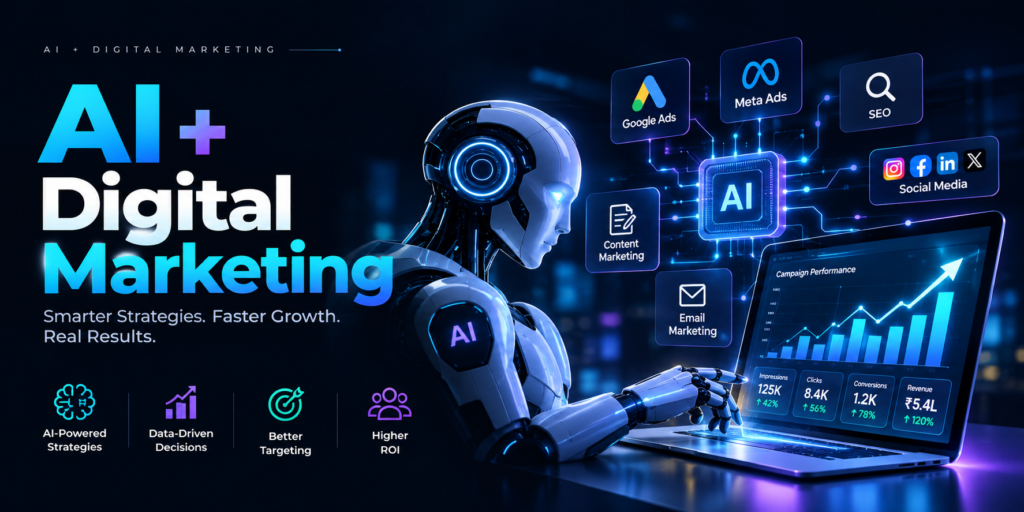
🤖 AI + Digital Marketing: How Artificial Intelligence Is Transforming Business Growth in 2026 Artificial Intelligence (AI) is no longer a futuristic concept. It has become an important part of how businesses approach digital marketing, customer acquisition, content creation, SEO, advertising, analytics, and customer engagement. From generating content ideas to analyzing customer behavior and optimizing advertising campaigns, AI is helping marketers work faster and make more informed decisions. For businesses, the bigger question is no longer “Should we use AI in digital marketing?” It is: “How can we use AI effectively without losing the human element of marketing?” In this guide, we explore how AI is changing digital marketing in 2026, the benefits it offers, practical use cases, and how businesses can use AI to build more effective marketing strategies.   What Is AI in Digital Marketing? AI in digital marketing refers to using artificial intelligence technologies to analyze data, identify patterns, automate repetitive tasks, personalize customer experiences, and support marketing decisions. Traditional marketing often depends heavily on manual research and execution. AI can help marketers process large amounts of information much faster. For example, AI can help businesses: Analyze customer behavior Identify audience segments Generate content ideas Assist with keyword research Personalize marketing messages Analyze advertising performance Predict customer behavior Automate repetitive marketing tasks Improve customer support Identify potential conversion opportunities However, AI should not replace marketing strategy. Instead, businesses should use AI as a tool that enhances human expertise and decision-making. Why Is AI Becoming Important for Digital Marketing? Digital marketing generates enormous amounts of data. Every website visit, search, click, advertisement interaction, purchase, social media engagement, and email interaction can provide valuable information. The challenge is turning this information into actionable insights. AI can process large datasets and identify patterns much faster than humans can manually. This can help marketers answer questions such as: Which customers are most likely to convert? Which advertising campaigns are producing the best results? Which content topics are attracting the most qualified visitors? Where are potential customers dropping out of the conversion funnel? Which audiences should receive different messages? This makes AI particularly valuable for businesses focused on improving marketing efficiency and return on investment. 1. AI-Powered SEO Search engine optimization is one of the areas being significantly influenced by AI. Marketers can use AI to assist with: Keyword research Search intent analysis Content planning Competitor research Content briefs Internal linking opportunities Topic clustering Content optimization SEO audits SERP analysis For example, instead of manually brainstorming dozens of related topics, marketers can use AI to identify potential subtopics around a primary keyword. However, simply generating large amounts of AI-written content is not a sustainable SEO strategy. The objective should be to create content that is: Useful Original Accurate Relevant Easy to understand Written for the target audience AI can assist with the process, but strategy and quality remain essential. 2. AI for Content Marketing Content marketing requires a constant flow of ideas. AI can help marketers accelerate different stages of content production. For example, AI can assist with: Content Ideas Businesses can use AI to generate topic ideas based on customer questions, products, services, and industry trends. Content Outlines AI can help create structured outlines that marketers can then refine using their own expertise. Content Repurposing A single long-form article can be transformed into: LinkedIn posts Instagram captions Short-form video scripts Email content Infographics Social media posts Content Personalization AI can also help businesses create variations of marketing messages for different customer segments. The important point is that AI should be treated as a content assistant, not a replacement for human expertise. 3. AI-Powered Google Ads Paid advertising is another area where AI can play an important role. Modern advertising platforms already use machine learning to optimize campaigns based on signals such as audience behavior, conversions, and campaign performance. Marketers can also use AI to assist with: Ad copy variations Keyword research Audience analysis Campaign analysis Performance reporting Budget allocation Landing page analysis Conversion optimization For example, instead of running one advertisement and assuming it will work, marketers can develop multiple creative variations and analyze which messaging generates better engagement and conversions. The goal isn’t simply to get more clicks. It is to generate better-quality traffic and profitable conversions. 4. AI for Social Media Marketing Managing multiple social media platforms can be time-consuming. AI can help businesses streamline the process. It can assist with: Content calendars Caption generation Content ideas Hashtag research Social media analytics Audience insights Video scripts Content repurposing For example, a business could take one long-form blog article and use AI to develop a week’s worth of social media content from it. This allows marketing teams to spend more time on strategy, creativity, community building, and customer engagement. 5. AI and Customer Personalization Consumers increasingly expect brands to provide relevant experiences. Instead of showing exactly the same message to every customer, businesses can use data and AI to personalize communication. Examples include: Product recommendations Personalized emails Targeted advertisements Customized website experiences Personalized offers Customer segmentation For an e-commerce business, for example, AI could help identify customers who frequently purchase a particular category and enable the business to create more relevant campaigns for those customers. Personalization can make marketing communication more relevant and potentially improve engagement and conversion rates. 6. AI for Customer Support AI-powered chatbots and virtual assistants can help businesses handle common customer queries. They can assist with questions about: Products Services Pricing Order status Availability Appointment scheduling Frequently asked questions This can allow businesses to provide support outside traditional working hours while reducing the amount of repetitive work handled manually. However, complex or sensitive customer issues should still have a clear path to human assistance. 7. AI-Powered Marketing Analytics Data is at the heart of successful digital marketing. Businesses need to understand not just how much traffic they are receiving but what that traffic is actually doing. AI can assist marketers in identifying patterns across: Website traffic Advertising performance Customer behavior Conversion rates Customer acquisition costs

SEO
SEO & Digital Marketing

SEO & Digital Marketing Blog Ideas

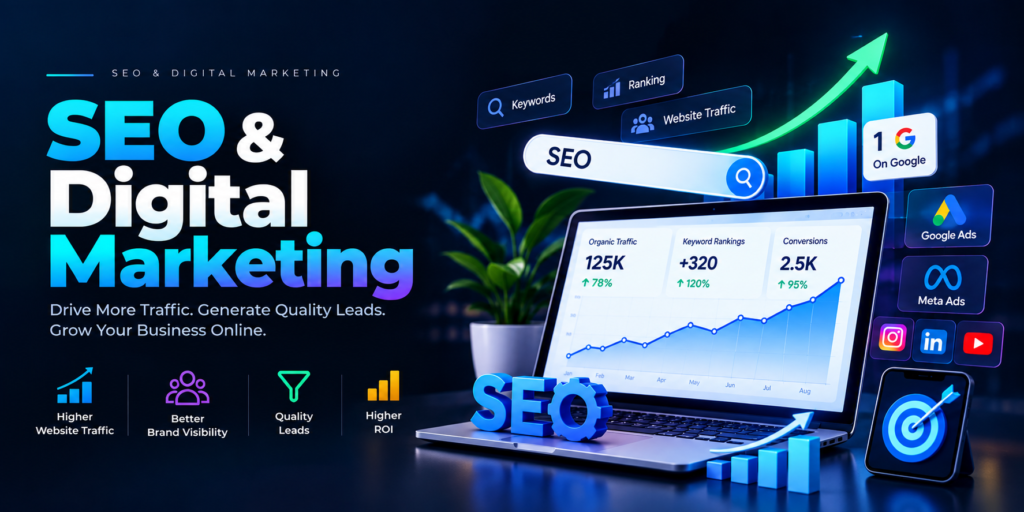
SEO & Digital Marketing Blog Ideas: 50+ Topics to Grow Your Business in 2026 In today’s competitive online landscape, simply having a website is not enough. Businesses need a consistent digital marketing strategy to attract the right audience, build brand visibility, generate leads, and increase sales. One of the most effective ways to build your online presence is through SEO and digital marketing content. A well-planned blog can help your business rank on search engines, answer customer questions, establish authority, and generate qualified traffic over time. But coming up with fresh and valuable blog topics consistently can be challenging. If you are looking for SEO and digital marketing blog ideas, this guide gives you more than 50 topics that businesses, marketers, startups, and entrepreneurs can use in 2026. Why Blogging Matters for SEO and Digital Marketing Blogging is more than publishing articles on your website. When done strategically, it can become an important part of your digital marketing funnel. A good blog can help you: Increase organic search traffic Target relevant keywords Build topical authority Generate qualified leads Educate potential customers Improve brand credibility Support your sales funnel Create content for social media Increase website engagement Build internal links to important service pages For example, a digital marketing agency can publish articles about SEO, Google Ads, social media marketing, content marketing, website conversion optimization, and AI. These articles can attract people who are researching digital marketing solutions and eventually convert them into potential customers. 50+ SEO & Digital Marketing Blog Ideas 1. General Digital Marketing Topics These topics are ideal for businesses that want to educate their audience about digital marketing. 1. What Is Digital Marketing? A Complete Guide for Businesses in 2026 Explain the fundamentals of digital marketing and the different channels businesses can use to reach customers online. 2. 10 Digital Marketing Strategies Every Business Should Use Discuss practical strategies such as SEO, paid advertising, social media, email marketing, content marketing, and conversion optimization. 3. How to Create a Digital Marketing Strategy That Actually Works Explain how businesses can define their goals, identify their target audience, select channels, allocate budgets, and measure performance. 4. Digital Marketing vs Traditional Marketing: Which Is Better? Compare the advantages, limitations, costs, targeting capabilities, and measurement options of both approaches. 5. How Much Does Digital Marketing Cost in India in 2026? Break down typical costs for SEO, Google Ads, social media marketing, website development, content marketing, and agency services. 6. How Long Does It Take to See Results From Digital Marketing? Explain why different marketing channels produce results at different speeds and what businesses should realistically expect. 7. 10 Common Digital Marketing Mistakes Businesses Should Avoid Cover mistakes such as targeting the wrong audience, ignoring SEO, having poor landing pages, and failing to track conversions. 8. How to Choose the Right Digital Marketing Agency for Your Business Create a practical checklist covering experience, services, case studies, communication, reporting, pricing, and measurable results. 2. SEO Blog Ideas SEO remains one of the most valuable channels for businesses looking to generate sustainable organic traffic. 9. What Is SEO and How Does It Help Your Business Grow? Introduce search engine optimization and explain how it can increase visibility and organic traffic. 10. SEO for Small Businesses: A Complete Beginner’s Guide Explain how small businesses can use SEO even with limited marketing budgets. 11. How to Rank Your Website on Google Cover important SEO fundamentals including keyword research, useful content, technical SEO, backlinks, user experience, and local search. 12. On-Page SEO vs Off-Page SEO: What’s the Difference? Explain the difference between optimizing your own website and building authority through external signals. 13. What Is Technical SEO and Why Is It Important? Discuss website speed, crawlability, indexing, mobile usability, structured data, site architecture, and other technical factors. 14. 10 SEO Mistakes That Can Hurt Your Google Rankings Help businesses identify common problems that may prevent their website from performing well in organic search. 15. How to Find the Right Keywords for Your Business Explain keyword research, search intent, long-tail keywords, competition, and commercial keywords. 16. Local SEO: How to Get Your Business Found on Google Show local businesses how to improve their visibility for location-based searches. 17. How Long Does SEO Take to Show Results? Explain why SEO is generally a long-term strategy and which factors influence the time required to generate meaningful results. 18. SEO vs Google Ads: Which One Should Your Business Invest In? Compare organic and paid search based on cost, speed, sustainability, targeting, and business objectives. 3. Google Ads & PPC Blog Ideas Paid advertising can provide businesses with immediate opportunities to reach potential customers, but campaigns need to be structured and optimized properly. 19. Google Ads for Beginners: A Complete Guide for Businesses Explain campaign types, keywords, ads, bidding, budgets, conversions, and performance tracking. 20. How Much Should You Spend on Google Ads? Help businesses understand how to establish an advertising budget based on their objectives and expected customer acquisition costs. 21. Google Ads vs Meta Ads: Which Is Better for Your Business? Compare search intent, audience targeting, creative requirements, costs, and conversion potential. 22. How to Reduce Your Google Ads Cost Per Lead Discuss keyword selection, negative keywords, landing pages, ad relevance, targeting, bidding, and conversion optimization. 23. 10 Google Ads Mistakes That Waste Your Advertising Budget Highlight common problems such as broad targeting, poor conversion tracking, irrelevant keywords, and weak landing pages. 24. What Is ROAS in Google Ads? Explain Return on Ad Spend and how businesses can use it to evaluate advertising performance. 25. How to Improve Your Google Ads Conversion Rate Cover landing page optimization, ad copy, audience targeting, offers, calls to action, and conversion tracking. 4. Social Media Marketing Blog Ideas Social media allows businesses to build awareness, engage their audience, and generate demand. 26. Social Media Marketing Strategy for Small Businesses Explain how businesses can select platforms, create content, build communities, and measure results. 27. Instagram Marketing: How to Grow Your Business Organically Cover content formats,

Scroll to Top